Monday, October 14, 2019

I Inherit a Tenor Banjo

My brother Ted, an accomplished guitarist, passed away on April 5, 2019.  I greatly miss him, but I did inherit a tenor banjo and his favorite Stratocastor guitar to remember him by.

I immediately ordered some instructional books on tenor banjo, and have been studying it  As a rhythm player it is good to finally study a lead instrument.  I am proceeding through the book well and learning the chords in each key.  Some of these chords seem almost impossible to play, as you have to really stretch those fingers out to get all the right notes.  Since there is only four strings, it's mo doubt easier than playing a six string guitar.  Playing the chords gets easier each time I pick up the banjo.  You are building muscle memory and it comes easier than you might think.

I am learning in the jazz duning of CGDA, from top to bottom of the neck.  There are several tunings that you might choose, but this is the one I want, and it seems most instructional books teach playing in this key.

More about the banjo later.


Monday, August 20, 2018

Becoming a Competent Musician: Playing Instrumentals Helps

To become a jazz musician, or any genre of musician, you must practice consistently over time, both with other musicians and alone.  Progress will be incremental over time.  You will not wake up one day and voila:  you are a competent musician.  You will get better little by little and you will reach plateaus of achievement. 

It is very helpful to record yourself, especially when playing with other musicians or a band.  Do this for both practices and actual gigs.  The feedback is invaluable.  You can learn what you are doing right and what needs improvement.

I record all the practices with my band.  Over a year and a half, while listening to the recordings, I notice that I wince less than before!  I hear fewer missed beats, fewer wrong chords, better rhythms.  I can tell I am progressing and it is encouraging.

Yesterday, Sunday, August 19th, we had our usual Sunday practice.  Our singer couldn't make it, so we used the opportunity to polish our instrumentals.  It's a different trip to play just instrumentals, because the lead instruments (guitar and piano, in our case) have to carry the lead by themselves. 

Have a listen to the practice here:  www.soundcloud.com/gwaltrip.


Tuesday, July 31, 2018

A Practice Routine That Seems to Work

In the past month I have finally hit on a practice routine that works for me.  (I play bass and my chosen genre is jazz and jazz standards.)

I study each song in our set list by reference to the chords on the sheet music.  I go through the chords, experimenting on the best way to play major 7ths, minor 7ths, dominant 7ths, and minor 7ths flat 5s.  At band practice on Sunday I figured out how to play a 6 chord, like C6.  It has a unique and pleasant sound.

Each chord in a song doesn't stand alone and can't be taken separately -- the chord that follows is also very important.  You want to move from one chord to the next in a smooth, melodic transition -- this is called the bass line.  A walking bass line is a smooth transition from one chord (or arpeggio) to the next.

Before this approach can be effective, you need to know a bit of music theory.  You need to know scale tones, chord tones and intervals.  You need to know your finger board thoroughly. But how do you get this knowledge?

Most bass courses emphasize practicing scales and arpeggios, and this practice is important; but a little of it goes a long way.  Too much of it is boring and may even be discouraging.  I find that learning the elements of music is best achieved when the elements are being applied in a practical way:  you want to play a certain jazz standard.  So you play that standard over and over, trying different ways to play the arpeggios, different places on the neck where you can access the notes in the chord.  In the process of learning the song, you are also learning your instrument and training your ear.

How do you become a jazz musician?  One professional jazz man said you do it by learning tunes.

Monday, July 30, 2018

We Play Instrumentals

Last Friday our singer was ill, so couldn't make practice, so we worked on instrumentals.  I liked this, because instrumentals are a different experience and add variety to our repertoire.

I can hear my bass much better and that helps me better judge how I am doing and learning.

Give a listen to our practice songs at www.soundcloud.com/gwaltrip, under the date of July 29, 2018.  The songs arfe marked with this graphic:


I am playing a Fender fretless Jazz Bass.


Wednesday, July 18, 2018

Devising Bass Lines for Jazz Standards

Last week my jazz group had a gig at the Slapface Coffee & Tea Cafe in Fremont, CA.  To prepare for the gig, I practiced the songs on my own (as well as with the band).  I record every practice and gig with my H5 Handy Recorder, then upload them to www.Soundcloud/gwaltrip for the band members to review.  Some of the songs are tight and others are not, particularly when we are playing new songs for the first time.

We have another gig this Sunday (July 22, 2018) at the Big Basin Cafe, on Big Basin Way in Saratoga.  There will be a car show on the street and we are expecting a good crowd. [Update:  gig was postponed due to a scheduling mixup.]

I am continuing my own approach to arpeggios and learning the songs:  I go through the sheet music and experiment with the chords, how best to play a minor 7th flat 5 while transitioning to the next chord, for example.  What sounds best?  What's the best way to play a major 7th chord?  This experimentation has yielded knowledge and new sounds from my fretboard.  It helps me remember  how to handle various chord arrangements during performance.

Various jazz musicians have said that memorizing the songs is the best approach.  You must know each song thoroughly, to play it through smoothly without mistakes, without getting lost.  Memorization is the way to do that.

Saturday, June 9, 2018

Know Your Arpeggios! The Stuff of Which Great Bass Lines Are Made.

I have been using Crescendo music notation software for the past few days, to write out bass lines, to experiment with arranging the notes in the chords (arpeggios to us bassists), to gain understanding of what works and what doesn't.  To do this, I need to know what notes are in a particular chord, such as A-7, BbMaj7, B-7(b5), etc.  I have these notes partially memorized, but I am not completely there yet.  So I refer to arpeggio charts (that I made myself in Excel), to see what notes are available.

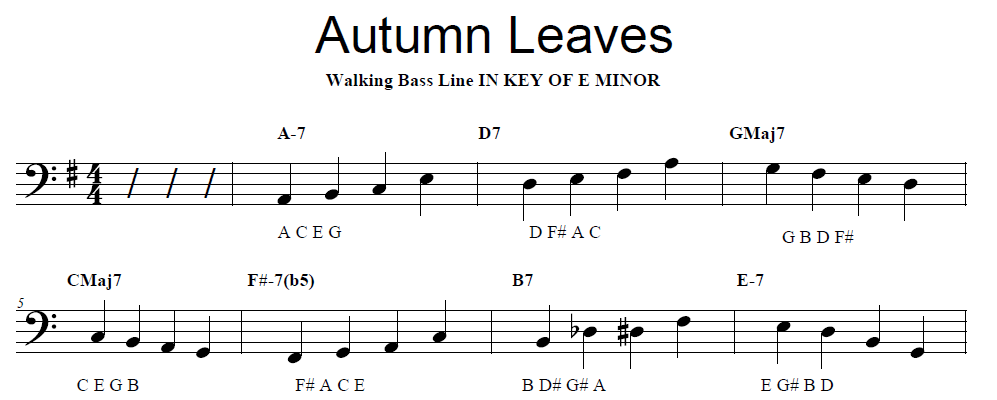
For example, here are the first two lines of Autumn Leaves, written out in Crescendo music notation software (which is very easy to use).  (Click in the image to see full size):

A free version of Crescendo Music Notation software is available for download,  and the licensed version for home use is a bargain at $35 ($50 for business use).  See this link.

To facilitate building the bass line, I put the chord notes just below each bar.  For example, the notes in A-7 (A minor 7) are A, C, E & G.  Then I put quarter notes in each bar that correspond to the chord notes, but arranged in an ascending or descending order, and using passing notes where needed.  (Note:  the notes below each bar show the notes in order, but the notes in the bar above are arranged differently).  For example, the first bar is A-7 and the notes in A-7 are A, C, E & G.  However, the notes written in the bar are A, B, C and E.  (The B is a passing note, not a chord note).  In the next bar we have D7 (D dominant 7) and the notes are D, F#, A and C, but the notes I used in the bar are D, E, F# and A.  The E is a passing note.

You may need a reference of arpeggios in order to create your own bass lines.  Here is a graphic I made of major 7 chords, dom 7 chords, minor 7 chords, and minor 7 flat 5 chords.  This chart may help you learn your arpeggios, as well as choose notes for each bar in your compositions.


Please report any errors you may see.

Wednesday, June 6, 2018

Building Great Bass Lines

If you want to be a great bass player, you need to understand chord structures and bass lines.  A great bass line is a string of notes that move smoothly from one chord to the next.  Generally the notes go up and then come down, a nice swing from low to high to low again.

I am really into studying bass and the composition of bass lines to jazz standards.

I am using my musical notation software to write walking bass lines to jazz standards.   This is giving me insights into jazz and chord structures.

My musical notation software allows me to write out a sheet of music, using the notes that I choose myself.  Then it lets me play the music back on my computer, so I can hear how the composition sounds.  If I don’t like the sound, I can change the notes to make it better.

I am studying something called “voice leading,” which means that when you play one chord (say Cm7 followed by F7), you move from the last note in C7 to the nearest note in F7, not necessarily to the root note, but to whatever note is closest.  It could be the 1st, 3rd, 5th or 7th of F7 in this example, but it can also be a passing note, a note in the respective scale that is not a note in the chord.

You could play Cm7 followed by F7 using chord notes in order:  C Eb G Bb  --  F A C Eb and it would work but sound dorky.  Using voice leading you could smooth out the bass line by playing the chords in this order:  C D Eb G, F G A C.  of course, D is not a note in Cm7 and G is not a note in F7, these are passing notes that smooth out the bass line and it sounds good.  The best use of passing notes are on the 2nd and 4th notes in the chord.

I am writing out a bass line to Autumn Leaves in G minor (Bb major) just to solidify my understanding.  I won’t do this for every song in my repertoire, but I will study each song separately to get the gist.

More about this later.

Saturday, May 26, 2018

Networking With Other Musicians; When to Walk Away

I read an ad on Craigslist for a jazz bassist and jazz drummer for a gig in Santa Cruz, California.  So I alerted my favorite drummer Stan and we proceeded to the practice.  The man who was organizing the gig is a very nice guy but clearly not ready for a serious gig, so we politely demurred and proceeded to the nearest Santa Cruz coffee shop, Coffeetopia.  I recommend it.  The coffee was, for me anyway, better than Starbucks. 

To be a working musician, you need to create as large a circle of musical associates as you can.  However, before doing that, you must be ready to gig.  Working on your own talent with practice and ongoing study is essential, plus practicing with a band, however early in its development.

However, the coffee was good and Stan and I had a pleasant chat.

Sunday, February 18, 2018

Names for Western Bands

I am always seeking names for bands among the daily barrage of broadcasts, news and media.  Yesterday I was listening to the Blues Brothers sing "Soul Man."  The opening line starts off "I'm comin' atcha on a dusty road...good lovin' I've got a truck load."

See the band name hiding there?  It's "Dusty Road."  I think that would be a good name for a country and western band.

A good band name, I think, is two words that create a mental image that ties in with the band's genre.  The two words are a noun and an adjective.  You can also use one word, usually a noun.

It's a fun exercise.  Some examples off the top of my head:

Spurs
Side Saddle - a real name of a western girl band
Rawhide
Hellbent for Leather
Ghost Riders (name of a famous song)
Cinco Amigos -- A Mexican music quintet
Starlit Night
Campfire Cousins
Bullwhip
Chaw

Monday, January 15, 2018

Minor 7th Arpeggios

To change a major 7th into a minor 7th arpeggio, you flat the third and the seventh notes.  See chart below.